After more than half a century, humanity is returning to the Moon, and Czech technology will be right there at the forefront. When the Artemis II mission lifts off in February 2026, six specialized chips from the Prague-based company ADVACAM will be on board to monitor cosmic radiation and ensure the safety of the crew.
A Historic Return to the Lunar Orbit
When the massive SLS (Space Launch System) rocket ascends from NASA’s Kennedy Space Center in Florida, it will mark the first crewed lunar mission since Apollo 17 in 1972. The first launch window is scheduled for February 6, 2026. During the ten-day mission, the four-person crew will not land but will orbit the Moon to test all critical life-support systems. This mission serves as the final rehearsal before Artemis III, which aims to return humans to the lunar surface in the coming years.
The Heart of the HERA System
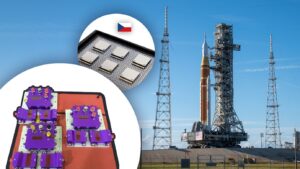
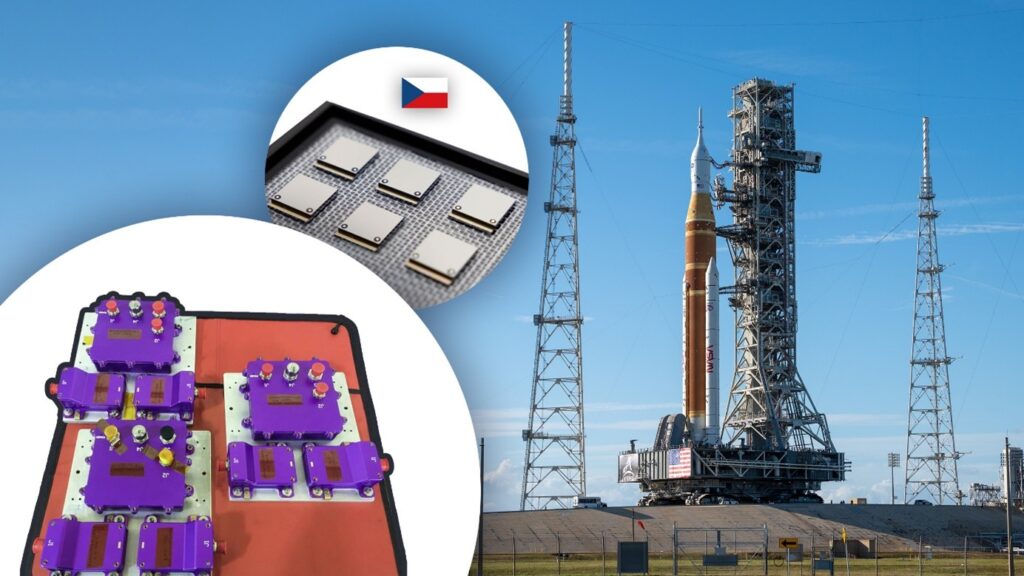
A vital component for the mission’s success is the HERA (Hybrid Electronic Radiation Assessor) system. This NASA-developed instrument is designed to monitor cosmic radiation, which can severely impact both human health and sensitive onboard electronics. The “eyes” of the HERA system consist of six Timepix chips supplied by ADVACAM. These are integrated into two HSU (Hera Sensor Unit) units, with three modules each. “These are extremely sensitive pixel chips capable of detecting every single particle of cosmic radiation and determining its energy, direction, interaction time, and particle type,” explains Jan Jakůbek, ADVACAM’s Scientific Director. “This allows for a detailed analysis of the radiation’s composition, which is essential because different particles have different biological effects.”
From CERN to Deep Space
The technology behind these chips originated in fundamental physics research at CERN’s Large Hadron Collider (LHC). Today, ADVACAM is a NASA-certified supplier. Their detectors are already a standard in the industry, having been deployed on:
-
The International Space Station (ISS)
-
The OneWeb Joey Sat satellite
-
Czech CubeSats VZLUSAT I and II
-
The future lunar orbital station Gateway (as part of the ESA IDA system)
Jan Sohar, CEO of ADVACAM, adds: “We are proud that NASA plans to use our chips during the final attempt to land on the Moon as part of the Artemis III mission. It is a clear indication that detailed radiation measurement is becoming an increasingly important part of human spaceflight.”
AdvaSpace: “Space Weather” Forecasting
The Czech ambition extends beyond hardware. At the end of 2025, the group established a new subsidiary called AdvaSpace (part of Advisiones Technologies). Its goal is to move from hardware production to data processing. The company envisions a satellite constellation using MiniPIX SPACE detectors to provide real-time “space weather” data. This information would be invaluable not only to space agencies but also to:
-
Aviation companies
-
Power grid operators
-
Insurance providers
“Our goal is to share space weather data much like meteorological satellites provide information about terrestrial weather,” says Martin Tyburec, Director of AdvaSpace. The company is currently seeking partners and investors to realize this ambitious vision.
The full press release, along with visual materials, can be found here.
Photo: SLS launch vehicle, detail of the HERA system installed in the Orion spacecraft, and Timepix chips. Source: NASA / SRAG-JSC / ADVACAM